












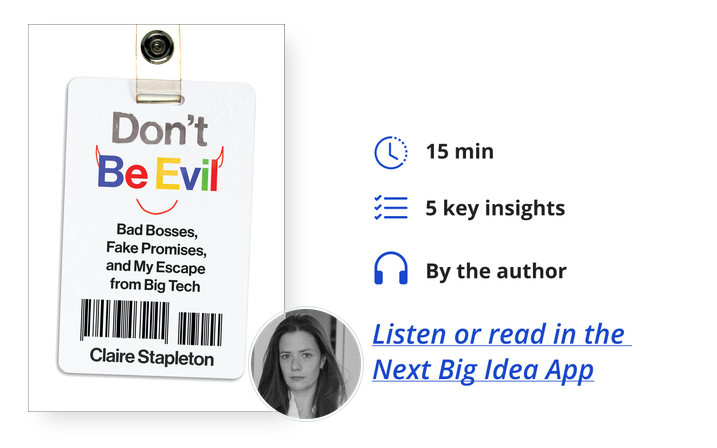
Below, Claire Stapleton shares five key insights from her new book, Don’t Be Evil: Bad Bosses, Fake Promises, and My Escape from Big Tech.
Claire spent twelve years at Google, joining straight out of college in 2007 and rising to become a senior communications leader at YouTube. In 2018, she co-organized the Google Walkout—in which 20,000 employees protested the company’s handling of sexual harassment—and left Google shortly after. Don’t Be Evil is her memoir about that journey.
What’s the Big Idea?
Almost all of us spend our waking lives inside institutions of one kind or another. We navigate their promises, absorb their values, and often mistake their identity for our own. Don’t Be Evil is a story about Google—but it’s really a story about how any of us navigate power, ambition, loyalty, and conscience inside the organizations we give our working lives to. The question it keeps asking is deceptively simple: where do you end, and where does the place you work begin?
Listen to the audio version of this Book Bite—read by Claire herself—in the Next Big Idea App, or buy the book.
1. The institution you work for tells a story about itself—and it could become yours.
When I joined Google in 2007, it didn’t feel like joining a company. It felt like joining a movement. Google recruited people with enthusiasm and idealism, talked constantly about its mission to organize the world’s information, and promised that we could all change the world together. The unofficial motto was “Don’t Be Evil” —and here’s the thing: it didn’t feel like marketing copy. It felt sincere. I believed it.
I wasn’t there for the free lunch (although the free lunch was pretty lovely). I was there because I wanted my work to matter, and Google handed twenty-something employees an enormous amount of responsibility, wrapped in an even bigger sense of moral purpose. Looking back, I think the most powerful thing a company can offer isn’t money. It’s meaning.
But once your identity is fused to an institution’s story, you stop being able to see the gap between the story and reality. You rationalize: This is just an exception. Leadership must know something I don’t. You defend the narrative, not because you’re naive, but because defending it is how you defend yourself.
This isn’t a Google problem. It’s a university problem, a newsroom problem, a nonprofit problem, a movement problem. Anywhere that offers you purpose along with your paycheck, this is the deal you’ve made, whether you noticed you or not.
2. Culture is a far more powerful form of control than hierarchy.
When people picture power inside a company, they picture a boss giving orders. That’s not how Google worked, especially not in the early years.
Google wasn’t just exporting products. It was exporting a philosophy of work. Alongside Search, Gmail, and Maps came a whole set of ideas about how organizations should function: trust employees, flatten hierarchies, collaborate obsessively, give smart people freedom and they’ll build extraordinary things. The message wasn’t just that Google made great products. It was that Google had figured out a better way to work—and maybe even a better way to live.
People pulled all-nighters because they wanted to. They were trying to become the kind of people Google celebrated. There were shared rituals, shared language, shared values, and weekly all-hands meetings that felt less like status updates and more like revival services.
“Nobody wants to be the one who breaks the spell.”
Culture doesn’t tell you what to do. Culture shapes what feels normal, admirable, and even morally right. And because it feels voluntary, you don’t notice how much it’s steering you. When everyone around you believes they’re changing the world, asking an uncomfortable question can feel like betraying something bigger than your employer. Nobody wants to be the one who breaks the spell.
Belonging is one of the greatest gifts a workplace can give you. But the moment belonging starts replacing your own judgment, it’s stopped being a gift.
3. Institutions change because people speak up, but people who speak up pay the price.
Organizing the Walkout was one of the proudest things I’ve ever done. It led to real changes, including the end of forced arbitration for hundreds of thousands of employees. I don’t regret it for a second. But I also don’t want to romanticize it.
Systemic change is incredibly hard because institutions are designed, almost by definition, to preserve themselves. Asking them to change means asking people with power to give some of that power up. That rarely happens without resistance. Accountability almost always depends on individuals willing to take personal risks on behalf of everyone else.
“Systemic change is incredibly hard because institutions are designed, almost by definition, to preserve themselves.”
I wish speaking up were rewarded as often as companies say it is. But my experience taught me that the people who make institutions better are not always the people those institutions know how to keep. So if you’re ever wrestling with whether to say something difficult, know this: the risk you’re feeling is real. But so is the possibility that your courage will make things better for people you’ll never even meet.
4. Technology carries the fingerprints of the incentives that built it.
I spent years helping tell YouTube’s story to the world during the exact years we were also grappling with extremism, misinformation, harassment, and algorithmic amplification blowing up into front-page news.
Every tech company is telling two stories at once. There’s the aspirational story: we’re connecting people, democratizing knowledge, empowering creators. And underneath it, quietly running the show, is the incentive story: How does this company actually grow? What gets rewarded in the building? What metrics move someone’s career? Where does the money come from? That second story shapes the product at least as much as the mission statement does—usually more.
This matters enormously as we walk into the age of AI. The question I’d push people toward isn’t “Is this technology good or bad?” It’s: who built it, what pressure are they under, and what does their business model need to be true? Technology doesn’t fall from the sky. It comes out of buildings full of people with quarterly targets.
5. Never let your identity live inside someone else’s institution.
For years, Google gave me an answer to the question: Who are you? It wasn’t just where I worked. It shaped what I believed about technology, progress, success, and even myself. Which is why leaving was so terrifying. I wasn’t just losing a job. I thought I was losing my identity.
I started at Google when I was 21, straight out of college, without having had much chance to figure out my own values yet. Google offered me a ready-made worldview, and I happily adopted it. For more than a decade, the company’s priorities became my priorities.
“Google offered me a ready-made worldview, and I happily adopted it.”
The funny thing is, once I left, I realized I hadn’t lost myself at all. I’d just mistaken my employer for my identity. Since then, one of the most rewarding challenges of my life has been deciding, for myself, what matters. What kind of work is worth doing? What kind of parent, friend, citizen, and person do I want to be? No company can answer those questions for you. They should never own your sense of self.
The unexpected gift of leaving Google was getting the chance to build a life around values I had chosen instead of values I had inherited. That’s harder than letting an institution tell you who you are. But it’s also infinitely more meaningful.
Enjoy our full library of Book Bites—read by the authors!—in the Next Big Idea App: