












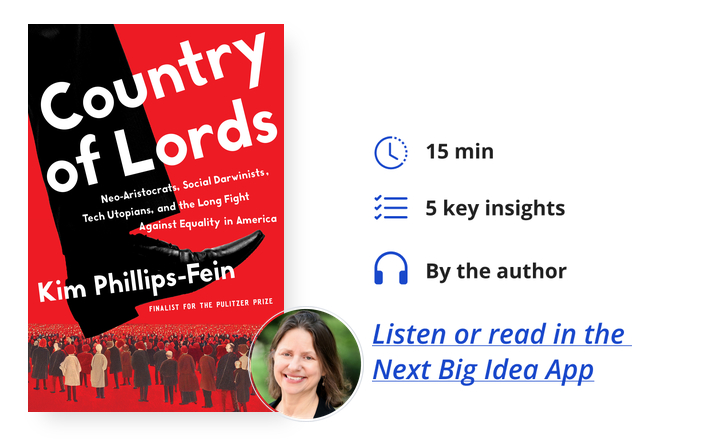
Below, Kim Phillips-Fein shares five key insights from her new book, Country of Lords: Neo-Aristocrats, Social Darwinists, Tech Utopians, and the Long Fight against Equality in America.
Kim is a historian and professor at Columbia University. She is also the author of Fear City, a finalist for the Pulitzer Prize.
What’s the Big Idea?
American history contains a long tradition of resisting economic equality and defending hierarchy as natural, necessary, or even beneficial. Understanding that tradition helps us see that equality is not about making everyone the same. It is about preventing wealth and power from becoming so concentrated that democracy itself is threatened.
Listen to the audio version of this Book Bite—read by Kim herself—in the Next Big Idea App, or buy the book.
1. America has resisted equality.
The idea that “all men are created equal” is often seen as central to American history. But many prominent figures in American history have strongly opposed the idea of equality, especially when it comes to any suggestion that material resources should be distributed more equally. When we look at their ideas, we can see a long pattern of resisting egalitarianism, which often has been accompanied by hostility to democratic government.
Today, we live in an extraordinarily unequal society, economically speaking. The top one percent of American society takes home 21 percent of all the annual income. The top one percent earns more than 26 times the average annual income of the bottom 99 percent, according to the Economic Policy Institute. The wealthiest one percent of Americans control about 30 percent of the nation’s wealth, while the bottom half of the population owns 2.5 percent.
An extremely unequal society is one in which vigorous defenses of inequality will flourish.
2. Arguments that defend inequality are repetitive, but not all the same.
People who have tried to argue that economic inequality is inevitable and necessary have not always done so in the same way. The arguments used have varied across time.
In general, arguments in defense of economic inequality have grown more strident and insistent, shifting from ambivalent skepticism about egalitarianism to an increasingly aggressive stance that economic inequality is not only inevitable but a positive good for all of society.
In the era of the American Revolution, Founding Fathers, such as John Adams, were skeptical about the claim that all men are created equal. Poor people, Adams wrote, were “destined to labor,” and they needed to labor in order to make possible the reproduction of society as a whole. For this reason, Adams was fearful of the French Revolution, and he also distanced himself from the great advocates of egalitarianism—especially Thomas Paine.
“Founding Fathers, such as John Adams, were skeptical about the claim that all men are created equal.”
This was different from the arguments put forward by pro-slavery advocates in the years before the Civil War. Although racism was always inextricable from a defense of slavery—the only way to justify enslavement was to see those enslaved as different from oneself—some Southerners recognized that they needed a defense of hierarchy that was more universal. They argued, to quote Virginian George Fitzhugh, that people were not “created or born equal,” and that slavery and hierarchy were “too universal not to be necessary to nature.” Civilization required a class of people to carry out “menial” duties. The North, no less than the South, relied on this.
These arguments have much in common, but are also different. And they differ, too, from the ways that hierarchy was defended after the Civil War, in the era of the Industrial Revolution, let alone with the advent of the corporation, the idea of the “meritocracy,” and more contemporary ideas about the market distributing rewards in a way that may be starkly unequal but is in the interests of all.
3. Right-wing ideas are more mainstream than we think.
We sometimes associate the promotion of hierarchy with extremism. But people who have defended inequality are not marginal or fringe figures: many of them were social and economic leaders in their own day. In moments of extreme economic inequality, such as our own, we often see defenses of inequality flourishing.
The people I write about in the late nineteenth century are figures such as William Graham Sumner, a Yale professor who argued that the “millionaires were the product of natural selection.” And Andrew Carnegie, one of the wealthiest men in the United States at the time. Carnegie was anxious that the extreme concentration of wealth from which he benefited was creating a fragile and precarious society. He argued that the way to make it okay was for the very wealthy to give their money to philanthropic institutions such as libraries and concert halls, so that the working class could come to understand that the concentration of wealth was really in their own interest.
Henry Ford also scorned the idea of equality, arguing that the corporation and the assembly line were naturally based on a hierarchy of roles, which was necessary to create material wealth. More recently, free-market advocates such as Milton Friedman insist that “life isn’t fair,” that some people just have gifts and talents others don’t, and that this justifies earning far more than others. And we see tech billionaires today suggesting that “founders” have a very special role in economic life—that these geniuses can intuit technological marvels and miracles, and that it is legitimate for them to profit from them.
None of these people are marginal: they are wealthy, prominent, successful people at the pinnacle of their societies.
4. Equality doesn’t mean conformity or uniformity.
I’m a historian, not a political theorist, so I am more interested in how people have used the idea of equality than I am in how we define equality in the abstract. People don’t use the idea of equality to suggest that all people are the same or that they should have exactly the same amount of material possessions. Instead, the historical record suggests that equality matters because it is a claim about what people deserve and what kinds of economic structures make democracy possible.
“Equality matters because it is a claim about what people deserve.”
A society in which wealth is very concentrated will be one in which a small number of people have disproportionate power. It will be one in which rich and poor live in very different social worlds, which makes any common interest difficult to establish. And it will be one in which political leaders are susceptible to corruption. This is why revolutionaries and activists have pressed for equality and sought to secure it as one of the preconditions of democratic life.
5. The rhetorical strategies used to defend hierarchy can be part of challenging it.
Recognizing the persistence of anti-egalitarian politics and thought in the U.S. matters because it gives perspective on these themes and helps us imagine how to build a more equal and democratic society. Writing this book might seem like it would have been depressing, but even when we profoundly disagree with an idea, it is very important to deeply engage with it. When it comes to these ideas in particular, it helps us recognize how antithetical this worldview is to the one most of us still share: one that believes in the importance of shaping a world that does not exalt some and denigrate others, but which is predicated on a sense of our common intelligence, humanity, and dignity.
Thinking about these ideas reminds us of the importance of values, not only policies. We hear a lot about “affordability,” but what is at stake in the hatred of social and economic hierarchy is so much more than this. It is, again, a desire for a certain kind of political world, in which the good of each is connected to the good of all, and in which we recognize—and protect each other against—the dangers of concentrated wealth. I even think a lot of the people I wrote about were uncomfortable or unhappy with aspects of the world they advocated for. The vision of equality (what Abraham Lincoln called the “electric cord” that joined Americans to each other) still pulled on them, even though they had turned against it.
Enjoy our full library of Book Bites—read by the authors!—in the Next Big Idea App: