










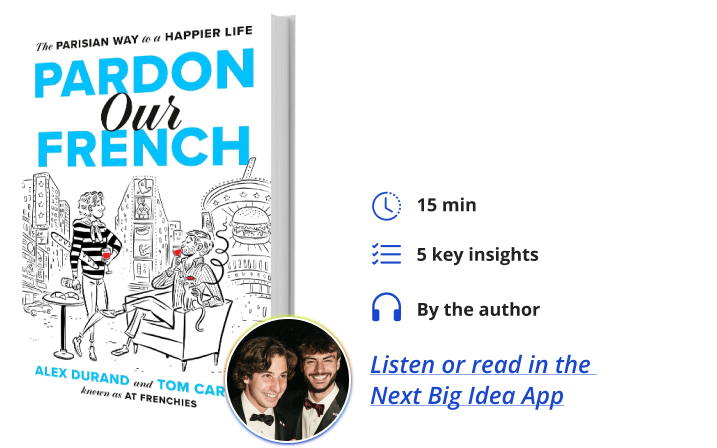
Below, Alex Durand and Tom Carles share five key insights from their new book, Pardon Our French: The Parisian Way to a Happier Life.
Alex and Tom are French content creators and co-founders of AT Frenchies, a community built around French culture, lifestyle, and the art of living well. They grew up outside Paris, moved to the United States at 18 to play college soccer, and have spent the years since exploring what their French upbringing can teach the world about slowing down, savoring more, and living with intention.
What’s the Big Idea?
The French art of living isn’t really about being French. It’s about resisting the urge to rush through life in pursuit of more, and instead becoming more curious, intentional, and attentive to what’s already around you. A good life is built not just through big achievements, but through ordinary pleasures, meaningful relationships, and moments we actually take the time to notice.
Listen to the audio version of this Book Bite—read by Alex and Tom—in the Next Big Idea App, or buy the book.
1. Stay curious, not perfect.
One of the most French things about the way we grew up was that we were constantly encouraged to question everything. In French school, getting a perfect grade is almost impossible. You could write what you think is the greatest essay ever written, get it back, and somehow it’s a 14 out of 20. What happened to the other six points? Basically, because there is always room to improve. That can be frustrating, but that mentality—that you’re never really finished learning—has stuck with us in a positive way.
Moving to America amplified our curiosity because suddenly everything was new. Why are strangers smiling at us? Why does everyone want to know how we’re doing? Why is there fried chicken at breakfast? And then Americans would ask us questions about France that we had never even considered. Why do French people eat dinner so late? Why do we take so long to drink one coffee? Why do French people debate so much? Sometimes our immediate answer was a shrug of the shoulders, but then we would go home and actually think about it. That’s ultimately how AT Frenchies started. The more questions people asked us about our culture, the more curious we became about it ourselves.
Adulthood can sometimes influence us to become overly comfortable with what we know, rather than curious about what we don’t. We stop asking basic questions because we think we’re supposed to already have the answers. But curiosity keeps life interesting. Learn five words in another language. Take a class you’re terrible at. Ask someone older than you about their childhood. Ask someone younger than you to explain something you don’t understand. And don’t do it because you need to become an expert. Do it simply because you don’t know yet. There’s something freeing about being able to say: I have no idea, tell me more.
2. Stop treating time like the enemy.
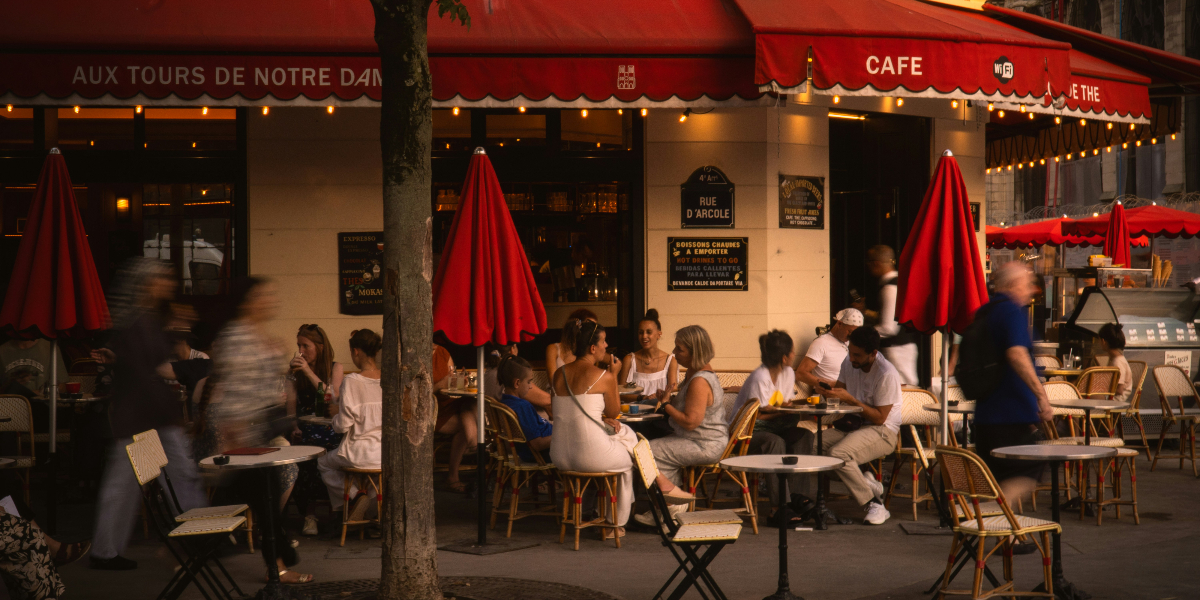
After living in America for years, we started noticing something every time we returned to France. We had become more impatient. We would sit down at a restaurant, finish eating, and want the check right away. But we had grown up here, and this manner of service was completely normal before we moved away. The waiter was not trying to ruin our afternoon. Nobody was rushing us out because, in France, the table is yours. Finish your meal, talk, sit there, and when you’re ready, ask for the check. Somewhere along the way, our relationship with time had changed. Any moment not spent accomplishing something had started to feel like wasted time.
“The French approach is not Don’t work hard, it’s Don’t make being exhausted your personality.”
That realization really stayed with us because we are ambitious. Building our business required periods when we were working constantly. At one point, our parents had to remind us that we’re not machines. They were not encouraging us to drop our dreams and become lazy. They were reminding us that you can sprint for a while, but eventually you need to recover. That’s an important distinction. The French approach is not Don’t work hard, it’s Don’t make being exhausted your personality.
A long lunch is not wasted time. A walk with someone you love is not wasted time. Sitting with a coffee and doing absolutely nothing for 10 minutes is not wasted time. Sometimes we’re so obsessed with saving time that we forget to ask what we’re saving it for. Work hard when it’s time to work hard. Chase the things you care about, but leave room for enjoying the life you’re working so hard to build.
3. Choose quality over quantity.
Growing up, we both heard versions of the same message from our families: the number of people around you matters much less than the quality of those relationships. When Tom was around 12, his dad told him something he thought was completely ridiculous at the time: When you grow up, you’ll probably have five people you can truly call your friends. Only five? At 12, Tom had way more than five friends. He basically thought his dad needed to get out there and make some more friends, but his dad was adamant that one day Tom would understand.
As we got older, we started to understand. Some friendships disappeared naturally—no fight, no falling out, just life happening. Eventually, we learned to invest more deeply in the people who genuinely mattered. Tom’s dad was right.
The lesson was about quality over quantity. This is an idea that shows up everywhere in French culture. In food, one really good piece of cheese is better than a giant plate of something mediocre. In fashion, it’s better to own fewer clothes that you genuinely love and will wear for years. In furnishing a home, something old or secondhand with a story is worth more than something new.
“Eventually, we learned to invest more deeply in the people who genuinely mattered.”
We’re surrounded by numbers that make us think that more is better—followers, likes, connections, things we own, , places we’ve visited, more, more, more, and more. Look around your own life and ask: where could you choose less? Maybe you don’t need more clothes. And maybe you don’t need more plans, you just need more time for the people you already love.
4. Pleasure doesn’t need to be earned.
Growing up in France, food was a big deal in both of our families. Not fancy food, just food. Meals were something we paid attention to. We learned about ingredients, tasted things, talked about what we liked and didn’t like. We learned to appreciate the quality and where food came from. Meals were not something squeezed between two other activities. We sat, talked, debated, and we enjoyed being there.
For Alex, some of those lessons started around the table with his dad, Bruno. Bruno was the kind of person who wanted you to pay attention to what you were eating. Alex remembers meals where the whole point was to slow down, taste the food, talk about it, and savor the moment together. As a kid, you don’t necessarily see the bigger philosophy in that. You’re just eating dinner with your family. But looking back, those meals were teaching something important.
Pleasure doesn’t always need to be earned. You don’t have to accomplish something extraordinary before you’re allowed to enjoy your afternoon. You don’t need a perfect diet before you’re allowed to eat the croissant. You don’t need a promotion to open a good bottle of wine. You don’t need to be on vacation to take a long walk, and you definitely don’t need a special occasion to invite people you love over for dinner.
Most of our lives are made of ordinary days. If happiness only happens when something huge occurs, then you’re ignoring a large percentage of your life. Pleasure can be really small: fresh bread that’s still warm, the first sip of coffee in the morning, music you love coming on while you’re driving, a dinner that somehow turns into a three-hour conversation. None of those things will completely transform your life, and that’s kind of the point. You don’t need to transform your life every day. Sometimes you just need to enjoy the day.
5. Pay attention to your life.
Growing up, nature was simply part of our lives. Tom’s grandparents had a house in front of a vineyard, and when he visited, his whole family would walk through the fields and feed the animals. There was a horse we named Pasta Crack, because for he absolutely loved uncooked pasta. As kids, we were not walking around thinking about sustainability. We were just having fun. But looking back, experiences like those shaped us.
Our parents and grandparents were what many would call eco-friendly. They grew basil or parsley near a window when they lived in apartments, or took care of plants on balconies. They reused things. They bought ingredients that were in season. They walked places. They appreciated their surroundings. Nobody sat anyone down and said, “Today, we’re going to learn how to respect the environment.” We just absorbed it.
“Your life is not waiting somewhere ahead of you.”
The same was true with art. These things were simply around us. Over time, we learned that you don’t have to be an artist to appreciate creativity or let it enrich your life. And that’s what so many of these little French rituals do. Going to the market, opening your windows in the morning, walking to the bakery, sitting down for dinner, having an aperitif with your friends, stopping for a musician playing on the street. They bring you back into your own life.
We spend so much time waiting for something better to happen—the next vacation, the next relationship, the next job, the next milestone—but your life is not waiting somewhere ahead of you. It’s right here, right now as you’re drinking your coffee, walking home, eating dinner or listening to a song for the hundredth time. You don’t need to become French to understand that. You just have to notice it.
Pardon our French is not about convincing you that the French have everything figured out. Trust us, we definitely don’t. It’s about taking the things that work wherever they come from and making them your own. Maybe that means a longer dinner. Maybe it’s protecting your Sunday morning. Maybe it’s buying fewer things, calling an old friend, learning something new, or just sitting with your coffee for five minutes without reaching for your phone. Start with one and see what happens.
Enjoy our full library of Book Bites—read by the authors!—in the Next Big Idea App: