











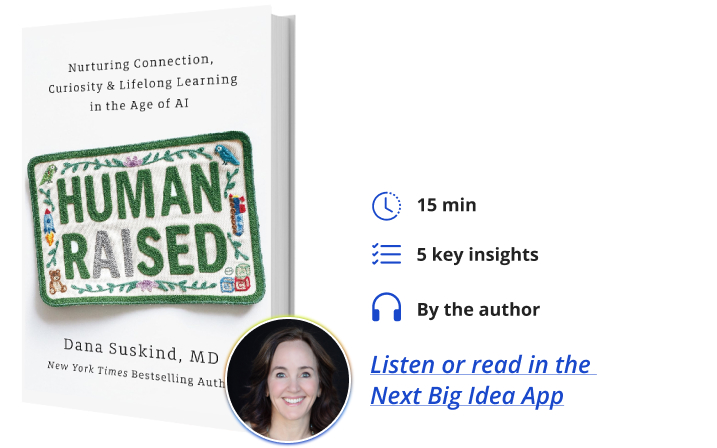
Below, Dana Suskind shares five key insights from her new book, Human Raised: Nurturing Connection, Curiosity & Lifelong Learning in the Age of AI.
Dana is a pediatric cochlear implant surgeon and social scientist at the University of Chicago. She co-founded and co-lead a research institute called The TMW Center for Learning + Public Health, where she and her team study foundational brain development.
What’s the Big Idea?
AI is poised to become one of the most powerful influences on early childhood, but no technology can replace the human relationships that build a developing brain. The challenge isn’t to reject AI—it’s to use it in ways that strengthen, rather than substitute for, the messy, imperfect interactions children need to flourish.
Listen to the audio version of this Book Bite—read by Dana herself—in the Next Big Idea App, or buy the book.
1. Never lose HOPE.
At the heart of Human Raised is a set of four guiding principles that I call the HOPE framework. It’s designed not so much as a rigid rulebook, but as a constellation of guiding lights to help parents make decisions about AI that align with what science tells us about healthy child development.
H: Human Connection is Irreplaceable. The developing brain is wired for interaction with other people. Eye contact, shared laughter, and the nurturing back-and-forth conversations between a child and a loving caregiver activate ancient neural circuits that no algorithm, however sophisticated, can replicate.
O: Own the Imperfections. Children don’t grow through perfect responsiveness. They grow through mismatches and repairs. When a parent missteps and then reconnects or when a child struggles with a sibling or disagrees with a friend, those moments of productive friction forge resilience, emotional regulation, and problem-solving capacity. Frictionless AI companions may seem appealing, but friction makes us human.
P: Protect the Early Years. Older children encounter AI with already-built neural scaffolding. Young children are still wiring the circuits that will govern all future learning and relationships. Introducing AI during this sensitive period presents a fundamentally different set of risks than doing so later in childhood.
E: Enhance, Don’t Replace Adult-Child Interaction. Tools that lighten parental burdens or deepen understanding can be genuinely beneficial. But when AI begins to replace core human interaction—when it stops being a co-pilot and becomes the pilot—parents gamble with consequences that are both unknown and potentially irreversible.
The HOPE framework is also a reminder that parents have inherent wisdom, and they should rely on it to navigate this rapidly shifting landscape.
2. Mind the social gate.
For the first time in human history, artificial entities have learned the passcodes to our most fundamental developmental gatekeeper. For millions of years, the infant brain’s social gate—the neural architecture that determines what experiences shape a child’s development—opened only for other humans. It was evolution’s way of ensuring that the most formative influences on a developing mind came from humans who could ensure that child’s survival.
Today, sophisticated AI systems and social robots have mastered the cues that open that gate. They can make eye contact, respond contingently, display emotional expressions, and engage in the back-and-forth dance that tells an infant brain: pay attention, this interaction matters. Research shows that infants as young as six to eight months display physiological responses to robots that parallel their reactions to humans. Two-year-olds will mimic a robot’s failed attempts at a task—but only if the robot first establishes eye contact, mirroring exactly the social conditions required for human teaching. AI has not just entered the nursery; it has, in a very real neurological sense, entered the developmental process itself.
“Infants as young as six to eight months display physiological responses to robots that parallel their reactions to humans.”
The danger is compounded by the extraordinary plasticity of the early years. What flows through the social gate during the first five years shapes the architecture of the human mind: the neural pathways formed, the attachment patterns established, the social expectations encoded during this period become the foundation for all future learning and relating. That’s why the intersection of AI and early childhood is the most important conversation we’re not having.
3. Find your Goldilocks zone of attachment.
Drawing on the foundational work of attachment experts like John Bowlby, I write about three core functions that a caregiver-child bond must fulfill to be secure:
- Proximity to Protection: the primal drive that makes an infant’s cry impossible to ignore and ensures access to nourishment and safety.
- A Secure Base for Exploration: the emotional foundation that allows a child to venture into the world knowing they can return to safety.
- Emotional Co-regulation: the thousands of soothing interactions that a child gradually internalizes, building neural architecture for lifelong emotional resilience.
Attachment is a spectrum. At one extreme lies insecure attachment, the product of inconsistent caregiving—a parent who is warm one moment, absent or harsh the next. At the other extreme is the risk for artificial attachment—a developmental hazard when a child’s relational expectations are shaped primarily by the flawless, endlessly patient responses of AI. These children may learn to expect instant gratification and perfect understanding, leaving them ill-equipped for the beautifully imperfect reality of human relationships. They may develop a preference for AI interaction and an intolerance for the messiness of genuine human connection.
In the middle lies the Goldilocks zone: secure attachment, which is built through consistent yet imperfect human caregiving. This is the “just right”—not too cold, not artificially perfect, but warm and real, with misunderstandings that get repaired and tensions that get resolved.
4. AI is like ultra-processed food.
Whole-wheat bread, canned beans, and frozen vegetables are processed, but they remain nourishing. Ultra-processed food is categorically different: it’s specifically engineered to override satiety signals, maximize consumption, and displace real nutrition. Human metabolism, which evolved during millennia of scarcity, is essentially defenseless against these products.
I see a direct parallel to the AI landscape. Some AI tools are the whole-wheat bread equivalent: technologies that help a parent understand a child’s sleep patterns or offer an overwhelmed teacher room to breathe. These support human connection without displacing it. But other technologies are the ultra-processed variety: systems engineered to erase natural stopping points, override the rhythms of boredom and curiosity, and smooth away friction.
“A child raised on frictionless technology may struggle with the slower, messier pace of real life.”
The developmental parallel is uncanny. Just like a child raised on hyper-palatable food may struggle to enjoy an ordinary apple, a child raised on frictionless technology may struggle with the slower, messier pace of real life, like the classroom that doesn’t adapt to their every whim, the friend who pushes back, or the exhausted parent who can’t compete with YouTube. It took decades to understand what ultra-processed foods were doing to our bodies. We can’t afford that same lag time when the developing brain is at stake.
5. Channel your inner DETECT-ive.
Without practical frameworks for applying these insights, parents will still feel like they’re walking through a maze without a map. Every new toy, app, and educational tool in the maze may carry hidden developmental costs. So, I created a six-question framework for evaluating specific AI systems. It’s called DETECT:
- D: Design — What is this thing designed to do? Is it built for education, entertainment, or companionship?
- E: Ethics — Was this product ethically trained? Does the training data represent diverse backgrounds, abilities, and communication styles, or does it embed biases that will be invisibly transmitted to your child?
- T: Trouble — Are there signs of troubling unintended consequences? Have other children been harmed by this tool in ways marketing doesn’t mention?
- E: Evidence — Is there independent evidence it works? Is there research beyond the company’s own claims that supports the product’s advertised benefits?
- C: Confidentiality — How will my child’s data be stored and used? Will it remain confidential, and who profits from it?
- T: Teachings — What is this system likely teaching my child — not just in its stated purpose, but in the values and expectations it encodes through repeated use?
Parents don’t need to become data scientists to use this. A surface-level scan will often surface enough red flags or enough confidence to make a call. And, of course, even a product that passes every DETECT question with flying colors is never required. The ultimate question is not whether the technology is good, but whether it genuinely enhances your family’s well-being in ways that justify its presence in your home.
Enjoy our full library of Book Bites—read by the authors!—in the Next Big Idea App: